

Our services
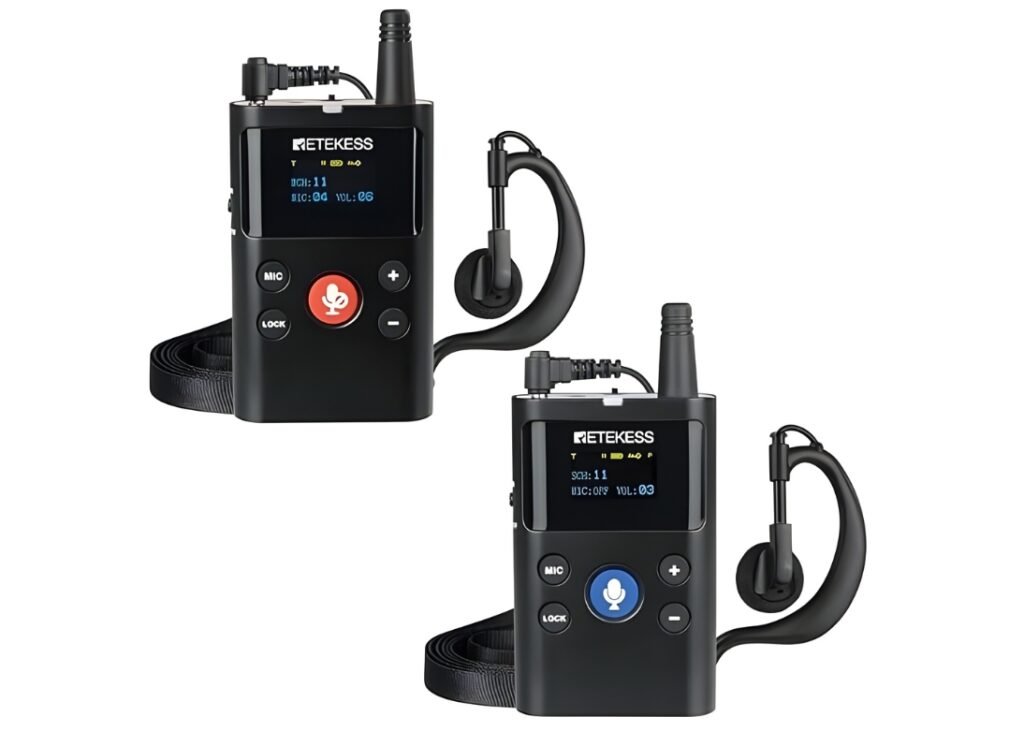
2 Way Tour Guide System
Interactive, reliable two-way group communication
Two-way tour guide systems enable real-time dialogue between the guide and participants. They combine a guide transmitter and transceiver equipped receiver units that include microphones so selected participants can ask questions or provide feedback without disrupting the group.
Best for: factory tours, site inspections, technical training, safety briefings, and any session where Q&A matters.
Request a QuoteOverview
A 2 Way Tour Guide System is a wireless communication solution that supports bi-directional audio. Each listener carries a lightweight receiver that may include a microphone and a push-to-talk (PTT) button or controlled speaking permission (moderator mode). The guide's transmitter broadcasts to the group while selected participants can respond improving interaction, safety and learning.
How it works (brief)
- Guide uses a transmitter with microphone and channel controls.
- Participants have receivers (with/without mic) tuned to the guide's channel.
- When a participant needs to speak, they use push-to-talk or the moderator enables their mic.
- System manages audio routing, echo suppression and may support multiple channels for parallel groups.
Features & Capabilities
Essential features
- Full-duplex / two-way audio: supports conversations between guide and participants (some systems use push-to-talk to manage turn taking).
- Digital wireless transmission: UHF/2.4GHz or proprietary digital links for stable audio and low latency.
- Noise suppression and echo cancellation: critical for industrial/noisy environments.
- Channel management: multiple channels enable simultaneous groups without cross-talk.
- Range & antenna diversity: typical operating ranges 50–300 m depending on power and environment; line-of-sight extends further.
- Battery & charging solutions: long run-time receivers (8–20 hrs) with charging cases or trays for quick turnover.
- Rugged & hygienic accessories: replaceable earhooks, disposable earpads, and IP-rated units for tough sites.
Advanced capabilities (optional)
- Remote channel change and device management from a central console.
- Roll-call / attendance, out-of-range alerts and low battery warnings.
- Integration with PA systems, interpretation consoles, or recording devices.
- Selective mic enabling (moderator assigns speaking rights to specific participants).
Business & Operational Benefits
- Improved safety: participants can ask questions during safety briefings and clarify procedures in real time.
- Better knowledge transfer: interactive sessions increase retention and reduce misunderstandings in technical tours.
- Operational efficiency: fewer repeat sessions; one session can serve both demonstration and Q&A.
- Scalable & flexible: systems can scale from small groups to large plant tours by adding receivers and repeaters.
- Lower cost vs trained bilingual staff: enables multilingual tours with interpreters or local guides using two-way tech.
Example System Setups
Small guided tour / classroom (10–30 people)
- 1 guide transmitter (lapel or headset), 15–30 receivers (earhook or earbuds)
- Charging tray and lockable transport case
- No extra repeaters needed; simple channel setup
Factory inspection / safety briefing (30–100 people)
- 1 guide transmitter + 50–120 transceiver receivers with push-to-talk
- Site survey and radio planning to avoid interference with other equipment
- Technician for setup and real-time monitoring (recommended)
Large/complex sites & multiple groups (100+ or multi-zone)
- Multiple guide transmitters with coordinated channels, RF repeaters/antenna diversity
- Central control unit for channel / microphone moderation
- On-site technical team and spares (batteries, headsets)
Typical Technical Specifications (Reference)
| Parameter | Typical Value / Note |
|---|---|
| Transmission | Digital UHF / 2.4 GHz or proprietary digital RF |
| Communication Mode | Two-way full-duplex or half-duplex with push-to-talk |
| Channels | Up to 99 channels (device dependent) for multi-group use |
| Range | 50m–300m typical; up to 500m line-of-sight with high power or repeaters |
| Battery Life | 8–20 hours per receiver; transmitters often 8–15 hrs |
| Latency | <100 ms (low-latency digital systems) |
| Ingress Protection | Some models IP54/IP65 for dusty or damp environments |
| Accessories | Charging cases, lanyards, earhooks, disposable eartips, spare batteries |
Buying Guide What to look for
Before you buy: define your group size, venue type (indoor/outdoor), critical noise sources, and whether you need moderator control or interpretation integration.
Top checklist
- Range requirement: indoor open halls vs narrow factory aisles run a site walk if possible.
- Battery life & charging: choose units with enough runtime or fast charging and supply spare units for multiple sessions.
- Speech clarity: digital systems with noise reduction and EQ deliver better intelligibility.
- Two-way control: push-to-talk (PTT) vs moderator-allowed mic choose what fits your workflow.
- Durability & hygiene: robust casings, washable headsets or disposable eartips for industrial sites.
- Compliance & frequency planning: ensure devices operate within local RF regs; consider licensed frequency if required.
- Service & spares: availability of spare headsets, batteries and local warranty/technician support.
Pitfalls to avoid
- Buying solely by price cheaper units may underperform in noisy or large venues.
- Not planning for battery replacement or charging logistics.
- Using 2.4GHz systems in crowded Wi-Fi environments without testing.
Installation, Testing & Best Practices
- Conduct a venue RF/coverage survey before the event identify interference sources and dead spots.
- Place transmitters and antennas to maximize area coverage and minimize multipath issues.
- Set volume limits and test intelligibility from multiple points in the group.
- Train guides on PTT etiquette and mic hygiene (sanitise earpads between uses).
- Provide quick start instructions on each receiver: channel change, volume and PTT.
- Have spare batteries, 5–10% extra receivers and a technician on standby for large or mission-critical events.
Mini Case Example
Scenario: A manufacturing client with multiple parallel safety tours (80 people) across factory floors.
Solution: Two guide transmitters, three channels for simultaneous groups, 100 receivers with earhooks, onsite technician, and repeaters for shielded areas. Outcome: reduced briefing time by 35% and no missed safety instructions during plant induction.
Frequently Asked Questions
What's the difference between push-to-talk and full-duplex two-way?
Push-to-talk (PTT) is a half-duplex mode where a participant holds a button to speak; full-duplex allows simultaneous speaking like a phone. Many tour systems use PTT to control talk turns and reduce background noise.
How many participants can a two-way system support?
Systems are scalable — many vendors allow hundreds of receivers. Practical limits depend on channel planning, available RF spectrum and receiver inventory.
Can the system be integrated with simultaneous interpretation?
Yes — two-way systems can be used alongside interpretation consoles or RF/IR interpretation receivers. Confirm integration options with your vendor.
How do I avoid interference in industrial environments?
Perform a site RF survey, choose the appropriate frequency band, use antenna diversity or repeaters, and allow for a buffer channel set to avoid local wireless equipment.
Ready to make your tours interactive?
We design and deliver two-way tour guide solutions with testing, training and on-site support. Tell us about your venue and attendee numbers.
Get a Tailored Proposal